
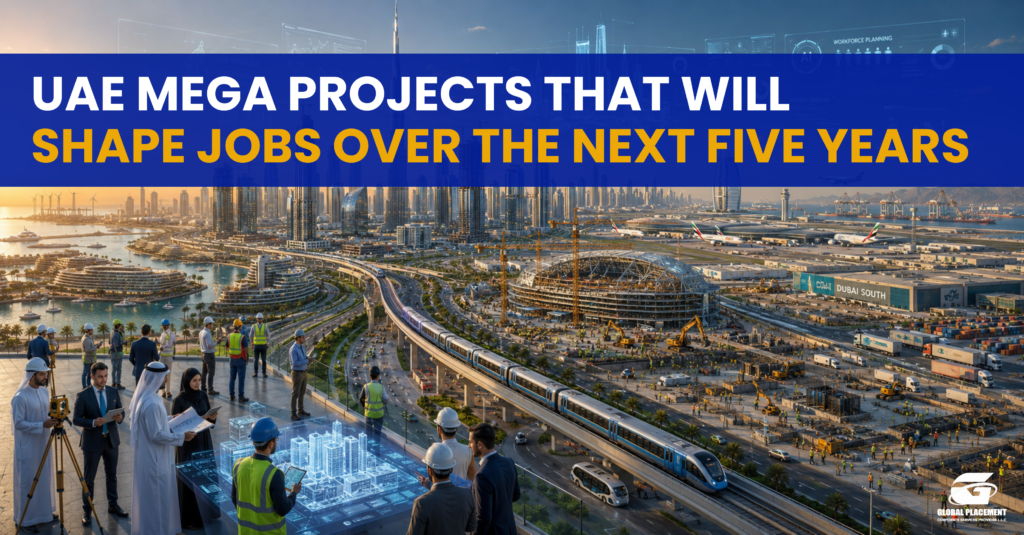
Why the Next Wave of Development Will Redefine Recruitment Across the Emirates
For decades, the United Arab Emirates has demonstrated an extraordinary ability to transform ambitious visions into globally recognized landmarks. From the Burj Khalifa to Palm Jumeirah and Expo 2020 Dubai, each generation of mega projects has done more than reshape skylines. They have created entirely new industries, attracted international investment, and generated hundreds of thousands of employment opportunities.
Today, the UAE stands at the beginning of another major development cycle. Over the next five years, billions of dirhams will continue flowing into infrastructure, transportation, tourism, clean energy, advanced manufacturing, logistics, healthcare, technology, and residential developments. While these projects will undoubtedly enhance the country’s global competitiveness, they will also create one of the largest workforce demands the region has experienced in recent years.
Most discussions surrounding UAE mega projects focus on architectural achievements or investment values. Far less attention is given to the human capital behind these developments. Every iconic building, industrial zone, railway expansion, luxury resort, or smart city depends on thousands of professionals working together across dozens of industries.
For employers, this presents both an opportunity and a challenge. Competition for skilled talent will become increasingly intense. Businesses that prepare their recruitment strategies early will gain a significant advantage over those that wait until projects reach peak construction or operational phases.
Although Dubai will remain the primary engine of employment growth, other emirates are rapidly expanding their own economic sectors, creating opportunities that extend well beyond construction alone.
Dubai: The Nation’s Largest Employment Generator
Dubai has evolved beyond being simply a tourism destination. It has become one of the world’s most diversified business hubs, where aviation, finance, logistics, hospitality, technology, healthcare, manufacturing, and real estate all contribute significantly to economic growth.
This diversification means future hiring will no longer be concentrated solely around construction workers. Entire ecosystems of professionals will be required before, during, and after each development is completed.
Several large-scale initiatives are expected to dominate hiring over the coming years.
Dubai South Continues Expanding
Dubai South is steadily becoming one of the Middle East’s most important integrated economic zones.
Centered around Al Maktoum International Airport, logistics corridors, residential communities, aviation businesses, and commercial districts continue to expand simultaneously.
While many associate Dubai South with aviation, the employment opportunities extend much further.
Companies operating within this ecosystem require:
- Civil engineers
- MEP engineers
- Logistics coordinators
- Warehouse supervisors
- Supply chain analysts
- Procurement specialists
- Project planners
- Facility managers
- Safety officers
- HR professionals
- Finance teams
- Customer service specialists
As businesses relocate into Dubai South, support industries naturally grow alongside them.
Al Maktoum International Airport Expansion
One of the most significant employment catalysts over the next decade will be the continued expansion of Al Maktoum International Airport.
When fully developed, it is expected to become one of the world’s largest aviation hubs.
Many people immediately think about pilots and cabin crew.
The reality is far broader.
Airport expansions generate demand for:
- Aircraft maintenance engineers
- Baggage handling systems specialists
- Airport operations managers
- Fire and rescue personnel
- Security professionals
- Ground transportation operators
- Cleaning contractors
- Catering services
- IT infrastructure teams
- Retail staff
- Hospitality workers
- Mechanical maintenance technicians
Thousands of indirect jobs are also created through hotels, restaurants, transportation companies, and logistics providers serving airport operations.
Dubai Metro Expansion Creates More Than Railway Jobs
Metro expansion is often viewed simply as transportation infrastructure.
In reality, it supports employment across numerous technical disciplines.
New stations require:
- Structural engineers
- Tunnel specialists
- Rail systems engineers
- Electrical technicians
- Signalling engineers
- Communications engineers
- Maintenance teams
- Safety inspectors
- Asset management specialists
After construction finishes, permanent operational roles continue for decades.
This makes transportation infrastructure one of the most sustainable long-term employment generators.
Hospitality Projects Continue to Drive Hiring
Dubai’s tourism ambitions continue expanding beyond luxury hotels.
Upcoming developments include:
- Integrated resorts
- Waterfront communities
- Entertainment districts
- Lifestyle destinations
- Beach developments
- Cultural attractions
- Sports venues
Each project requires years of workforce planning before opening its doors.
Recruitment begins long before the first guest checks in.
Hotels typically hire months ahead for:
- Hotel managers
- Executive chefs
- Sous chefs
- Restaurant supervisors
- Housekeeping managers
- Guest relations executives
- Front office associates
- Maintenance technicians
- Security personnel
- Spa therapists
- Recreation teams
The ripple effect extends into food suppliers, laundry services, transportation providers, event management companies, and facility management firms.
Dubai’s tourism sector therefore remains one of the most consistent employers across multiple skill levels.
Luxury Residential Communities Will Continue Expanding
Dubai’s population continues growing steadily.
International investors, entrepreneurs, digital professionals, and expatriates are driving demand for new residential communities.
Large master-planned developments require years of coordinated workforce deployment.
Initial hiring focuses on:
- Architects
- Urban planners
- Surveyors
- Civil engineers
- Structural consultants
- Construction supervisors
As projects progress, demand shifts toward:
- Electricians
- Plumbers
- HVAC technicians
- Tile masons
- Gypsum carpenters
- Aluminium fabricators
- Painters
- Welders
- Steel fixers
- Heavy equipment operators
Once communities become operational, entirely new hiring cycles begin.
Property management companies recruit:
- Facility managers
- Community managers
- Security officers
- Landscapers
- Cleaning teams
- Customer service executives
- Building technicians
A single residential development can therefore create employment opportunities for decades rather than only during construction.
Data Centres Are Quietly Becoming Major Employers
One of the least discussed employment trends in Dubai is the rapid growth of hyperscale data centres.
Artificial intelligence, cloud computing, financial technology, and digital transformation are driving unprecedented demand for secure computing infrastructure.
Unlike traditional commercial buildings, data centres require highly specialised talent.
Growing demand includes:
- Electrical engineers
- Mechanical engineers
- Critical facility managers
- Network engineers
- Cybersecurity professionals
- Data centre operators
- Cooling system specialists
- UPS technicians
- Fire suppression experts
This sector represents one of the highest-value employment markets emerging within the UAE.
Clean Energy Is Creating Entirely New Career Paths
Dubai’s sustainability goals are reshaping recruitment priorities.
Solar projects, energy-efficient buildings, green infrastructure, and smart utilities require professionals with increasingly specialised expertise.
Growing opportunities include:
- Renewable energy engineers
- Sustainability consultants
- Energy auditors
- Environmental engineers
- Building automation specialists
- Smart grid technicians
- Electrical project managers
Unlike traditional construction projects, these developments demand continuous innovation and technical upskilling.
Abu Dhabi’s Industrial Expansion Will Redefine Technical Recruitment
While Dubai remains the UAE’s commercial powerhouse, Abu Dhabi is quietly building one of the country’s strongest foundations for industrial employment. Over the next five years, large investments in manufacturing, clean energy, defense, healthcare, logistics, and advanced technology will significantly reshape hiring across the emirate.
Unlike tourism-driven employment, many of Abu Dhabi’s projects focus on long-term industrial operations. These developments require permanent technical teams that remain in place long after construction has finished.
Growth sectors are expected to create opportunities for:
- Mechanical Engineers
- Electrical Engineers
- Process Engineers
- Automation Engineers
- Robotics Specialists
- Maintenance Engineers
- Quality Assurance Professionals
- Health, Safety, and Environment (HSE) Officers
- Procurement Specialists
- Production Supervisors
- Industrial Electricians
- CNC Operators
- Instrumentation Technicians
As manufacturing facilities become increasingly automated, employers are looking beyond traditional engineering qualifications. They want professionals who understand robotics, predictive maintenance, industrial software, and smart manufacturing systems.
This shift means recruitment agencies and employers alike will need to identify candidates with specialized technical experience rather than simply filling vacancies based on job titles.
Ras Al Khaimah Is Becoming the UAE’s Manufacturing Powerhouse
For years, Ras Al Khaimah was primarily associated with tourism and ceramics.
Today, it is emerging as one of the UAE’s fastest-growing industrial economies.
New investments in manufacturing, logistics, real estate, hospitality, and infrastructure are accelerating workforce demand throughout the emirate.
One of the biggest reasons is affordability.
Industrial companies expanding operations often find Ras Al Khaimah attractive due to its strategic location, lower operating costs, and growing transport connectivity.
As more manufacturers establish regional facilities, recruitment demand grows across several areas.
Employers increasingly require:
- Factory Managers
- Production Engineers
- Warehouse Supervisors
- Inventory Controllers
- Forklift Operators
- Industrial Maintenance Teams
- Welders
- Fabricators
- Machine Operators
- Quality Inspectors
The hospitality sector is expanding as well.
Luxury resorts, beachfront developments, and tourism projects continue creating demand for chefs, hotel managers, housekeeping teams, guest relations professionals, and food and beverage specialists.
While Dubai receives much of the international attention, Ras Al Khaimah may become one of the UAE’s most underestimated employment markets.
Sharjah Is Building the Workforce Behind Regional Manufacturing
Sharjah has long served as an important industrial center, but recent investments continue strengthening its position.
Many businesses relocating from higher-cost markets are choosing Sharjah for manufacturing, warehousing, logistics, and industrial services.
This creates employment that often receives less publicity than Dubai’s skyline developments.
Instead of luxury towers, recruitment demand comes from factories, industrial parks, engineering firms, and supply chain operations.
Growing occupations include:
- Production Planners
- Supply Chain Coordinators
- Mechanical Technicians
- Industrial Electricians
- Quality Controllers
- Procurement Officers
- Logistics Managers
- Warehouse Operations Teams
- Industrial Designers
- Maintenance Supervisors
Sharjah’s education sector is also contributing to employment growth by producing graduates in engineering, healthcare, and technology who support regional workforce needs.
Fujairah’s Strategic Location Is Creating New Logistics Careers
Fujairah’s position outside the Strait of Hormuz gives it a unique advantage for maritime trade.
As port operations continue expanding, logistics and shipping companies are increasing investments throughout the emirate.
Unlike traditional construction projects, maritime logistics creates highly specialized employment opportunities.
These include:
- Marine Engineers
- Port Operations Managers
- Customs Specialists
- Cargo Coordinators
- Fleet Maintenance Engineers
- Shipping Documentation Officers
- Crane Operators
- Logistics Analysts
- Supply Chain Managers
- Warehouse Automation Specialists
As international trade volumes continue increasing, demand for logistics professionals is expected to remain strong for years.
The Hidden Jobs Most People Never Associate With Mega Projects
When people think about large developments, they usually imagine cranes, construction workers, and architects.
In reality, these visible roles represent only a fraction of the workforce.
Every mega project creates an extensive network of secondary employment that begins long before construction starts and continues years after completion.
For example, before a single building rises, companies recruit:
- Environmental consultants
- Land surveyors
- Legal advisors
- Procurement teams
- Financial analysts
- HR professionals
- Recruitment coordinators
- Project schedulers
- Contract administrators
- Document controllers
During construction, entirely different specialists become essential.
These include:
- Safety inspectors
- Material planners
- Equipment maintenance technicians
- Logistics coordinators
- Fleet managers
- Payroll administrators
- Camp managers
- Site nurses
- Occupational health professionals
Once projects are completed, another employment cycle begins.
Buildings require:
- Facility Managers
- Property Administrators
- Security Officers
- Maintenance Technicians
- Cleaning Teams
- Customer Service Staff
- Community Managers
- Leasing Consultants
- IT Support Specialists
- Building Automation Engineers
Many of these careers receive little media attention, yet they account for thousands of long-term employment opportunities across the UAE.
Recruitment Will Become More Competitive Than Construction
Perhaps the biggest story over the next five years is not the projects themselves.
It is the competition for qualified people.
As multiple developments progress simultaneously across Dubai and other emirates, employers will increasingly compete for the same engineers, supervisors, technicians, skilled tradespeople, hospitality professionals, and logistics specialists.
Waiting until a project reaches peak construction is no longer an effective hiring strategy.
Companies that establish talent pipelines early, build relationships with experienced recruitment partners, and proactively source international professionals will be better positioned to meet project deadlines without compromising quality.
The UAE’s next generation of mega projects will not simply redefine skylines. They will redefine workforce planning itself, making strategic recruitment one of the most important competitive advantages any employer can have.
Skills That Will Be in Highest Demand
The conversation around future employment often centers on how many jobs will be created. A more important question is which skills employers will struggle to find.
Over the next five years, UAE employers are expected to place greater emphasis on capability rather than simply years of experience. As projects become more technologically advanced and timelines grow more demanding, companies will seek professionals who can adapt quickly, work in multicultural environments, and contribute from day one.
For technical roles, employers will increasingly prioritize:
- Building Information Modeling (BIM) expertise
- Digital project management
- Sustainable construction practices
- Smart building technologies
- Industrial automation
- Robotics and AI-assisted manufacturing
- Data analytics for operations
- Cybersecurity for infrastructure
- Energy-efficient engineering
- Predictive maintenance systems
For skilled trades, certifications and proven hands-on experience will continue to be major advantages. Electricians, plumbers, HVAC technicians, scaffolders, aluminum fabricators, tile masons, pipe fitters, and welders with Gulf experience or internationally recognized certifications are likely to remain in high demand.
Soft skills are becoming equally important. Employers increasingly value professionals who demonstrate:
- Strong communication
- Leadership potential
- Problem-solving ability
- Adaptability
- Safety awareness
- Team collaboration
- Accountability
- Customer service mindset
The workforce shaping tomorrow’s UAE will not only build infrastructure but also operate, maintain, and improve it for decades to come.
Why Recruitment Strategies Must Evolve
Many companies still approach hiring reactively. A project is awarded, deadlines are established, and recruitment begins only after manpower shortages become apparent.
This approach is becoming increasingly risky.
Today’s labor market is far more competitive than it was even five years ago. Skilled professionals have more opportunities, shorter decision-making timelines, and higher expectations regarding employers.
Successful organizations are shifting toward workforce planning rather than emergency recruitment.
This includes:
- Forecasting manpower requirements months in advance.
- Building talent pipelines before vacancies arise.
- Partnering with experienced international recruitment agencies.
- Conducting technical assessments before deployment.
- Reducing time-to-hire through pre-qualified candidate databases.
- Investing in employee retention alongside recruitment.
Organizations that treat recruitment as a strategic business function rather than an administrative process are more likely to deliver projects on time and within budget.
International Recruitment Will Continue to Power UAE Growth
Despite investments in local talent development, the UAE will continue to depend on international professionals across numerous sectors.
Large-scale developments require specialized expertise that often needs to be sourced globally.
Professionals from countries such as India, the Philippines, Pakistan, Sri Lanka, Nepal, Egypt, and many European nations continue to play a vital role in supporting the UAE’s economic growth.
However, international recruitment today is no longer simply about filling vacancies.
Employers increasingly expect recruitment partners to provide:
- Thorough candidate screening
- Technical trade testing
- Credential verification
- Interview coordination
- Visa and documentation support
- Compliance with labor regulations
- Pre-deployment guidance
- Post-placement assistance
A comprehensive recruitment process minimizes hiring risks while helping businesses secure candidates who are both technically qualified and culturally prepared for the UAE workplace.
Looking Beyond Construction
Although cranes and skyscrapers often symbolize economic development, the jobs created by UAE mega projects extend far beyond construction sites.
Every completed development generates long-term demand across industries such as:
- Healthcare
- Hospitality
- Retail
- Facility Management
- Aviation
- Manufacturing
- Logistics
- Property Management
- Information Technology
- Finance
- Human Resources
- Education
- Customer Experience
For example, a newly developed residential community requires healthcare clinics, schools, supermarkets, restaurants, security providers, cleaning contractors, maintenance companies, banks, and transportation services.
Similarly, an industrial zone creates demand for accountants, procurement teams, warehouse operators, HR professionals, quality inspectors, IT specialists, and administrative staff alongside engineers and technicians.
This interconnected employment ecosystem demonstrates why mega projects have such a lasting impact on the UAE economy. Their influence continues long after construction is complete.
Preparing Today for Tomorrow’s Opportunities
The next five years represent a pivotal period for the UAE. Dubai will continue leading with transformative projects in aviation, logistics, tourism, luxury real estate, and smart infrastructure, while Abu Dhabi, Sharjah, Ras Al Khaimah, Fujairah, and the Northern Emirates strengthen their own industries through manufacturing, energy, ports, technology, and industrial expansion.
For employers, the challenge will not simply be finding workers but securing the right talent before competitors do.
For professionals, this is an opportunity to invest in technical skills, certifications, and continuous learning to remain competitive in an evolving job market.
The success of the UAE’s next generation of mega projects will ultimately depend on people. Behind every landmark, every transport network, every manufacturing facility, and every hospitality destination are skilled professionals whose expertise turns ambitious plans into reality.
Businesses that embrace proactive workforce planning, strategic recruitment, and long-term talent development will be best positioned to capitalize on the extraordinary opportunities these projects will create.
How Global Placement Can Support Your Workforce Needs
As demand for skilled professionals continues to grow across the UAE, partnering with an experienced recruitment agency can significantly reduce hiring time while improving workforce quality.
With more than 25 years of international recruitment experience, Global Placement Corporate Services Provider LLC supports employers across industries including construction, engineering, hospitality, healthcare, facility management, manufacturing, oil and gas, logistics, and other specialized sectors. Through its presence in the UAE, India, and Singapore, the company provides end-to-end recruitment solutions, from candidate sourcing and technical assessments to interview coordination, documentation, visa guidance, and post-placement support.
Whether your organization is preparing for a large infrastructure project, expanding operations, or building long-term talent pipelines, having access to qualified professionals at the right time can make a measurable difference to project success.
The UAE’s next chapter of growth has already begun. The organizations that prepare their workforce today will be the ones leading tomorrow.