
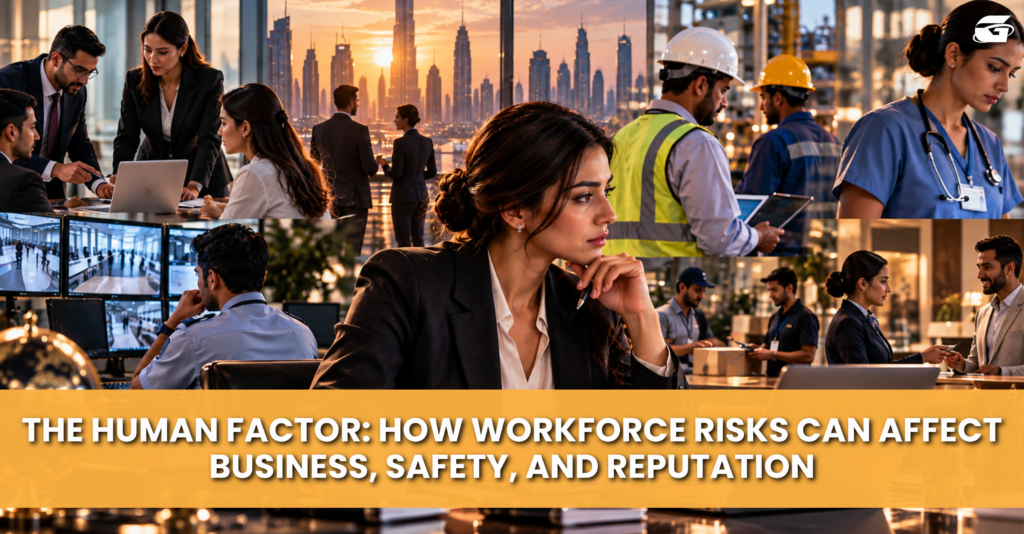
A company can invest millions in technology, infrastructure, security systems, and operational excellence. Yet one human decision can still expose the organization to financial loss, safety concerns, and reputational damage.
Every business depends on people.
Employees manage financial transactions, operate machinery, serve customers, handle confidential information, and make decisions that directly influence organizational performance.
Across organizations, a lapse in judgment may compromise workplace safety, a breach of trust may expose sensitive business information, and an act of misconduct may result in serious financial or reputational consequences.
Regardless of an organization’s size, industry, or operational environment, one fundamental challenge remains: managing the risks associated with human behavior.
This is where the human factor becomes a critical consideration in organizational risk management.
For employers in the United Arab Emirates, workforce risk management is no longer simply a question of hiring qualified individuals. It involves understanding how recruitment decisions, employee conduct, workplace culture, supervision, and organizational safeguards interact throughout the employment relationship.
The most important question is not whether businesses can eliminate human risk entirely.
It is whether they have built systems capable of managing that risk responsibly.
1. Understanding the Human Factor in Business
The human factor refers to the influence of human capabilities, limitations, decisions, and behavior on organizational performance.
In workplace risk management, this includes both intentional misconduct and unintentional errors.
An employee may make an operational mistake because of fatigue, inadequate training, unclear instructions, or excessive workload.
Another employee may knowingly violate procedures, misuse confidential information, or manipulate financial records for personal benefit.
These situations have different causes and require different responses.
A mistake does not automatically indicate dishonesty. Similarly, a deliberate violation of company policy should not be dismissed as a simple training issue.
Organizations must understand these distinctions before designing preventive measures.
In safety-critical industries, human factors analysis often considers communication, situational awareness, workload, supervision, and decision-making.
In corporate governance, the focus may extend to integrity, financial controls, conflicts of interest, and access to sensitive information.
Both perspectives are important.
A workforce can be technically competent but poorly supported by operational systems. Equally, an organization can have sophisticated systems but remain vulnerable when employees intentionally circumvent controls.
Effective workforce risk management requires attention to both individual behavior and the organizational conditions in which that behavior occurs.
2. Why Hiring Decisions Carry Long-Term Business Consequences
Recruitment is often evaluated through immediate business requirements.
Does the candidate possess the necessary qualifications?
Can the person perform the job?
Does the applicant have relevant industry experience?
Will the candidate fit within the organization’s salary budget and operational requirements?
These questions are essential, but they represent only part of the hiring decision.
Employers must also consider the responsibilities, access, and authority associated with the position.
A sales executive may gain access to customer databases and commercially sensitive pricing.
An accountant may process payments and handle financial records.
An IT administrator may control access to business-critical systems.
A healthcare professional may make decisions affecting patient safety.
An aviation professional may work within operational environments where compliance with established procedures is essential.
The consequences of an error or misconduct can vary considerably between these roles.
This is why a risk-based approach to recruitment matters.
The depth of candidate verification, professional assessment, and onboarding should reflect the legitimate requirements of the position.
However, even comprehensive recruitment procedures cannot guarantee future behavior.
Hiring due diligence reduces uncertainty. It does not eliminate human risk.
3. Beyond the CV: The Importance of Background Verification
A well-written CV can demonstrate professional experience, education, and career progression.
But a CV is primarily a candidate’s representation of their background.
Responsible recruitment requires employers to determine which information should be independently verified.
Depending on the position and applicable legal requirements, verification may include identity confirmation, employment history, academic qualifications, professional certifications, licensing, and relevant references.
For technical positions, practical assessments may help establish whether candidates possess the competencies they claim.
For management roles, structured interviews can provide insight into decision-making, professional responsibilities, and leadership experience.
In regulated professions, employers must also consider specific licensing and authorization requirements.
Verification should be relevant, consistent, lawful, and proportionate.
It should not become an excuse for unnecessary intrusion into a candidate’s private life.
Equally important, employers must recognize the limitations of background screening.
A positive employment reference cannot predict every future decision.
An authentic qualification does not establish personal integrity.
And an individual with no documented history of misconduct may still make a serious mistake or engage in wrongdoing later.
Background verification is therefore best understood as one part of a broader workforce assurance process.
4. When Human Decisions Put Business, Safety, and Reputation at Risk
Every organization relies on employees to make responsible decisions, follow established procedures, and exercise sound professional judgment.
However, even a single decision can create consequences that extend beyond an individual’s immediate responsibilities.
An employee may disregard an important safety procedure. A supervisor may overlook repeated operational concerns. A professional entrusted with sensitive information may exercise poor judgment. An individual may deliberately misuse the authority or access granted by an employer.
These situations differ in nature, but they share one important characteristic: human behavior can directly influence organizational outcomes.
Some incidents result from unintentional errors, inadequate training, fatigue, communication failures, or unclear responsibilities.
Others may involve negligence, deliberate policy violations, conflicts of interest, or intentional misconduct.
Understanding these distinctions is essential.
A mistake caused by insufficient training should not automatically be treated as deliberate wrongdoing. Similarly, repeated or intentional violations may require a different response from isolated human errors.
For employers, the challenge is not simply to identify who made a mistake, but to understand why the incident occurred and whether existing safeguards were adequate.
Were employees properly trained?
Were responsibilities and expectations clearly communicated?
Were appropriate supervision and reporting procedures in place?
Did the organization have mechanisms to identify warning signs before the situation escalated?
These questions help organizations move beyond individual blame toward meaningful risk prevention.
Recruitment due diligence can help employers evaluate relevant qualifications, professional experience, and competencies before employment begins.
However, responsible hiring must be supported by ongoing training, effective supervision, clear workplace policies, and consistent accountability.
A qualified employee is not automatically immune to human error, poor judgment, or misconduct. Likewise, even strong recruitment practices cannot compensate for weak organizational controls.
The broader lesson is clear: workforce safety, business integrity, and corporate reputation depend not only on whom an organization hires, but also on how it manages, supports, and holds its people accountable throughout their employment.
5. Employee Integrity: The Risks That Are Not Always Visible
Not all workforce risks involve physical safety.
Some arise from the misuse of financial authority, customer relationships, or confidential business information.
Consider a hypothetical service company.
An employee provides a service to a customer and collects payment in cash.
The transaction is never entered into the company’s point-of-sale system.
Because the service does not involve a physical product leaving inventory, management may have limited independent evidence that the transaction occurred.
If the payment was intentionally diverted before being recorded, the conduct may constitute revenue skimming.
The financial loss may appear small when viewed as a single transaction.
However, repeated irregularities can undermine revenue reporting, financial controls, and management confidence.
This scenario highlights the importance of transaction visibility.
Mandatory receipts, POS reconciliation, independent service records, and appropriate supervisory reviews can help organizations identify discrepancies.
The purpose of these controls is not to presume dishonesty.
It is to establish objective accountability.
Organizations should also distinguish between suspected misconduct and proven wrongdoing.
A missing transaction may result from a system failure, administrative error, or misunderstanding.
Any allegation requires appropriate verification before conclusions are reached.
6. When Confidential Business Information Becomes Vulnerable
Customer databases, commercial agreements, pricing structures, and internal business strategies can represent years of investment.
Employees may require access to this information to perform their duties.
But legitimate access does not necessarily authorize unrestricted copying, disclosure, or personal use.
Consider a hypothetical employee working in a travel agency, recruitment firm, or professional services company.
During employment, the individual develops customer relationships and gains access to confidential client records.
Before leaving, the employee copies a substantial amount of customer information to an unauthorized personal account.
If that information is later misused, the organization may face commercial, contractual, and data protection concerns.
However, employers must make an important distinction.
Employees are generally entitled to use their professional skills, experience, and knowledge when pursuing lawful career opportunities.
Starting a competing business does not, by itself, establish wrongdoing.
The concern arises where protected confidential information is improperly obtained, disclosed, or used.
Businesses should therefore implement appropriate confidentiality policies, role-based access permissions, secure data storage, and structured employee offboarding procedures.
For UAE employers, the handling of personal information must also comply with applicable data protection requirements.
Protecting confidential information is both a business responsibility and a matter of organizational trust.
7. The Connection Between Cybersecurity and Insider Threats
Cybersecurity is frequently associated with external attackers.
Businesses invest in firewalls, antivirus systems, encryption, and other technical safeguards to protect their digital infrastructure.
Yet information security also depends on the actions of authorized users.
An employee may accidentally disclose credentials through a phishing email.
A contractor may retain unnecessary access after completing an assignment.
A staff member may deliberately transfer confidential information outside approved systems.
These situations illustrate different forms of insider-related risk.
Some involve negligence or manipulation by external attackers.
Others involve intentional misuse of legitimate access.
Recruitment teams also handle sensitive information, including identity documents, employment histories, and professional credentials.
Organizations must ensure that this information is collected, stored, shared, and retained through appropriate processes.
Security awareness training, access restrictions, multifactor authentication, and documented reporting procedures can reduce vulnerabilities.
However, technical safeguards should operate alongside clear management responsibilities and appropriate employee policies.
Cybersecurity is not solely an IT issue.
It is part of workforce governance.
8. How Workforce Incidents Affect Corporate Reputation
The consequences of workforce incidents may extend far beyond their immediate operational or financial impact.
A service failure can damage customer confidence.
A data breach may affect client relationships and create regulatory obligations.
A workplace safety incident can raise concerns about operational standards.
Financial misconduct may prompt questions about management oversight and internal controls.
In today’s digital environment, information can circulate rapidly through news platforms and social media.
Public attention may develop before the underlying facts are fully established.
This creates an additional responsibility for organizations.
When incidents occur, employers should respond through accurate communication, appropriate investigation, and respect for the rights of everyone involved.
Speculation and premature accusations can create further harm.
Equally, ignoring legitimate concerns may undermine confidence.
A credible response demonstrates that the organization has processes for identifying problems, establishing facts, and implementing corrective measures.
Reputation is not protected by claiming that incidents can never occur.
It is strengthened when stakeholders can see that the organization manages risks responsibly.
9. Why Workplace Culture Matters as Much as Recruitment
Employee conduct does not develop in isolation from the workplace environment.
Leadership practices, communication standards, operational pressure, and organizational expectations can influence how employees approach their responsibilities.
A company may have detailed policies but struggle to enforce them consistently.
Employees may receive inadequate training or conflicting instructions.
Supervisors may prioritize short-term productivity while overlooking procedural compliance.
In some workplaces, staff may hesitate to report concerns because they fear retaliation or believe management will not respond.
These conditions can weaken organizational safeguards.
A healthy workplace culture establishes clear expectations while encouraging employees to raise legitimate concerns.
Management should communicate that safety, integrity, and accountability are fundamental responsibilities.
Employees should understand the procedures relevant to their roles and receive appropriate support when difficulties arise.
Fairness is equally important.
An organization that treats every mistake as misconduct may discourage transparent reporting.
Conversely, a company that consistently overlooks deliberate violations may weaken its own standards.
Effective leadership requires distinguishing between human error, risky behavior, and intentional wrongdoing.
10. Internal Controls: Trust Supported by Accountability
No recruitment process can predict every future action.
This is why organizations need internal controls throughout the employment relationship.
Internal controls are policies and procedures designed to support reliable operations, accurate reporting, legal compliance, and appropriate safeguarding of business resources.
In finance, this may involve independent payment approvals and regular reconciliation.
In sales, it may include mandatory transaction recording, receipt controls, and periodic reviews.
In IT, it may involve access restrictions and monitoring of relevant system activity.
In safety-sensitive operations, it may include competency assessments, procedural checks, and supervisory oversight.
A particularly important principle is segregation of duties.
Where practical, no single employee should exercise unchecked control over every stage of a sensitive process.
Smaller organizations may need alternative safeguards, such as management review or automated exception reporting.
Controls should be proportionate to the organization’s size, resources, and actual risks.
They should also be reviewed periodically.
A procedure that exists only in an employee handbook offers limited protection if it is not consistently followed.
11. Recognizing Warning Signs Without Creating a Culture of Suspicion
Organizations may identify unusual patterns that justify further review.
These can include repeated unexplained financial discrepancies, unauthorized changes to records, unusual access to confidential data, or recurring deviations from established safety procedures.
However, warning signs are not proof.
A financial discrepancy may result from an accounting error.
Unusual system access may have a legitimate operational explanation.
An employee’s performance difficulties may reflect inadequate training, workload, or personal circumstances rather than dishonesty.
Employers should therefore rely on documented procedures and objective evidence.
Reviews should be conducted fairly, lawfully, and with appropriate confidentiality.
Where misconduct is suspected, relevant employees should have an opportunity to respond through the organization’s established processes.
The goal is not to create a workplace where everyone is constantly viewed with suspicion.
It is to ensure that potential problems are identified and addressed before they develop into larger organizational failures.
12. The Role of HR in Workforce Risk Management
Human resources departments are central to recruitment and employee administration.
But workforce risk management requires a broader perspective.
HR can support the organization by establishing consistent recruitment procedures, coordinating relevant verification, developing employee policies, and facilitating training.
It can also help management define responsibilities, document performance concerns, and implement fair disciplinary processes.
However, HR cannot manage every workforce risk independently.
Finance must oversee financial controls.
Operational management must supervise daily activities.
IT and information security must protect digital systems.
Compliance and legal teams, where applicable, must assess relevant regulatory and contractual requirements.
Senior leadership must establish organizational priorities and allocate appropriate resources.
The strongest approach is collaborative.
When departments work independently without clear coordination, gaps can develop between recruitment, operational supervision, and risk management.
A unified framework helps ensure that employees are not only selected appropriately but also supported, trained, and supervised throughout their employment.
13. Why International Recruitment Requires Structured Due Diligence
The UAE’s workforce includes professionals recruited from a wide range of international markets.
This diversity contributes valuable expertise and supports the country’s business development.
However, international recruitment can introduce practical verification challenges.
Educational qualifications may originate from different systems.
Employment records may follow different formats.
Professional licensing requirements may vary between jurisdictions.
Job titles and responsibilities may also differ across organizations.
Employers therefore benefit from structured recruitment procedures that evaluate candidates consistently.
These may include document review, competency assessments, relevant employment verification, and role-specific interviews.
Where specialized checks are necessary, employers should use appropriate authorized channels and comply with applicable legal requirements.
Recruitment providers can support employers by coordinating candidate sourcing, screening, assessments, and documentation processes within the agreed scope of service.
They should also communicate clearly about which checks have been completed and which remain the employer’s responsibility.
Transparent recruitment practices help employers make informed decisions without overstating the certainty that any screening process can provide.
14. Building a More Resilient Workforce
Workforce resilience is not achieved through one policy, one recruitment interview, or one security system.
It requires a coordinated approach across the employee lifecycle.
Before employment, organizations should establish clear job requirements and conduct appropriate candidate assessments.
During onboarding, employees should receive training on operational procedures, ethical standards, confidentiality, and safety responsibilities.
Throughout employment, businesses should maintain effective supervision, access controls, and opportunities for professional development.
When concerns arise, organizations should respond through proportionate reviews and fair procedures.
During offboarding, access to company systems and sensitive information should be managed appropriately.
These measures should evolve as business operations change.
New technologies, different working arrangements, and expanding international operations may create new responsibilities and risks.
Organizations that regularly evaluate their workforce processes are better positioned to identify weaknesses and improve their safeguards.
The objective is not to eliminate trust from the workplace.
It is to create an environment where trust and accountability reinforce one another.
15. The Future of Responsible Recruitment and Workforce Governance
As organizations adopt increasingly sophisticated technologies, the importance of human judgment remains.
Automated systems may assist with recruitment administration, transaction monitoring, and access management.
Digital tools can improve visibility and help identify unusual patterns.
But technology does not replace responsible leadership.
Employers must still decide how to interpret information, respond to concerns, support employees, and maintain fair workplace practices.
Similarly, recruitment agencies must balance efficiency with accuracy, transparency, and respect for candidate rights.
For companies operating in the UAE, workforce governance should be viewed as a continuing business responsibility rather than a one-time hiring requirement.
A capable workforce is essential to organizational growth.
A well-governed workforce helps sustain that growth.
The two objectives are closely connected.
Conclusion: The Human Factor Is Everyone’s Responsibility
Every organization depends on human decisions.
Some decisions create opportunities, improve service quality, and strengthen business performance.
Others may introduce operational errors, financial losses, safety concerns, or reputational challenges.
The difference is not always explained by qualifications or professional experience alone.
Workplace systems, organizational culture, supervision, individual accountability, and effective leadership all influence outcomes.
This is why recruitment due diligence must be viewed as the beginning of workforce risk management, not the end.
Employers need qualified people, but they also need appropriate controls, continuous training, clear procedures, and fair accountability.
A strong CV cannot replace effective supervision.
A background check cannot guarantee future conduct.
And technology cannot compensate for every weakness in organizational culture.
The most resilient businesses are not those that assume human risk can be eliminated. They are those that recognize its complexity and take responsible steps to manage it.
Because in every industry, behind every process, every transaction, and every critical decision, there is a human factor.
And how an organization manages that factor can shape its business performance, safety, and reputation.
PLACEMENT 360 | GLOBAL PLACEMENT GULF
Insights on recruitment, workforce integrity, and responsible business practices.
Global Placement Gulf supports employers through international recruitment, executive search, bulk hiring, and candidate assessment services.
For recruitment partnerships:
hr@globalplacementgulf.com
www.globalplacementgulf.com