
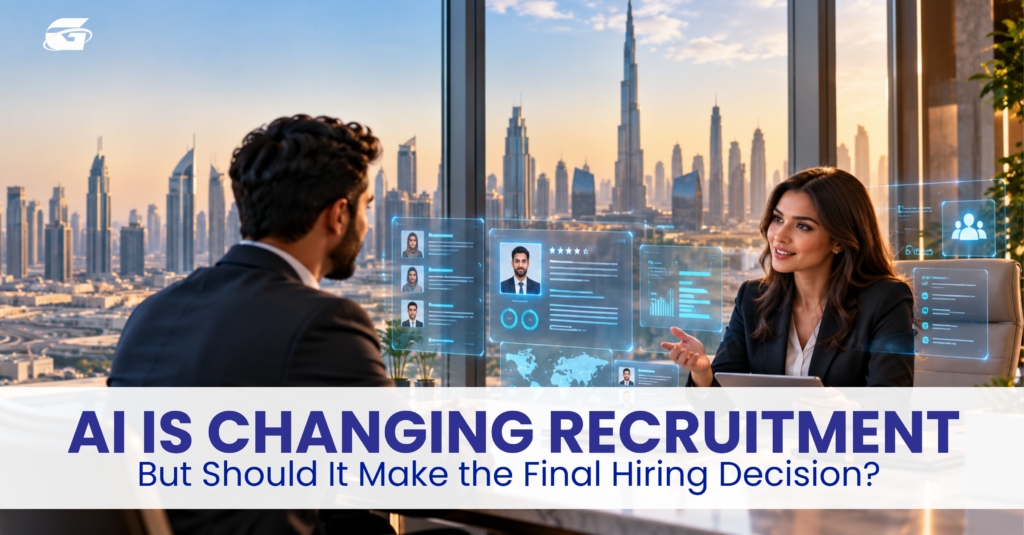
Artificial intelligence is transforming recruitment in Dubai and across the UAE. From CV screening and candidate matching to interview support and skills assessment, AI can make hiring faster and more data-driven. But as technology becomes more capable, employers face a more important question: should AI simply support recruitment, or should it be trusted to make the final hiring decision?
The UAE has established itself as one of the world’s fastest-growing markets for artificial intelligence talent and adoption. PwC’s 2026 UAE AI Jobs Barometer found that the proportion of UAE job postings requiring AI skills rose from 1.0% in 2021 to 3.2% in 2025, with AI-related demand increasing across every sector analysed. PwC
For Dubai, where companies compete for talent across technology, construction, engineering, hospitality, healthcare, financial services, logistics, real estate and professional services, the implications are significant.
Recruitment is no longer simply a process of collecting CVs, conducting interviews and choosing a candidate.
Technology can now analyse applications, identify skills, generate interview questions, compare candidates against job descriptions and help recruiters manage thousands of applications in a fraction of the time previously required.
Yet hiring remains fundamentally about people.
The most effective future of recruitment may therefore not be AI versus humans, but rather AI combined with informed human judgement.
AI Is Already Reshaping the UAE Labour Market
The growth of artificial intelligence in recruitment needs to be understood within the wider transformation taking place across the UAE economy.
The country is increasingly developing an AI-enabled workforce.
According to PwC, the UAE is now among the fastest-growing AI talent markets globally. AI-related job postings increased by approximately 2,700 between 2024 and 2025 alone. Technology, media and telecommunications currently show the greatest concentration of AI demand, with nearly 10% of job postings in that sector requiring AI-related skills. However, AI demand is also increasing across financial services, professional services, manufacturing, energy, consumer markets and healthcare. PwC
This development is particularly relevant to Dubai.
The city’s labour market attracts professionals from around the world, while employers regularly recruit both locally and internationally. Recent UAE labour-market reporting has identified active demand across technology, financial services, healthcare, logistics, real estate, construction and professional services, with AI fluency increasingly becoming a differentiator for candidates. Gulf News
At the same time, employers often face a practical recruitment challenge: volume.
A single vacancy advertised online can attract a large number of applications. Bulk recruitment projects can involve hundreds or thousands of candidates.
For organisations recruiting electricians, technicians, engineers, hospitality employees, healthcare professionals, drivers, construction workers or administrative personnel, manually reviewing every application can require substantial time and resources.
This is where AI becomes extremely valuable.
How AI Is Being Used in Recruitment
Artificial intelligence can support almost every stage of the modern recruitment process.
An AI-enabled recruitment platform may analyse a job description and identify the competencies required for a position. It can then review candidate profiles, search databases, compare qualifications and help recruiters identify applicants whose experience appears relevant.
AI can also assist with administrative recruitment work.
For example, technology can help organise candidate information, schedule interviews, generate candidate communications, summarise applications, identify missing documentation and create preliminary interview questions.
For organisations handling high-volume recruitment, these capabilities can significantly reduce repetitive work.
Consider a UAE construction company preparing for a new project.
The company may need:
50 electricians
40 plumbers
30 HVAC technicians
25 welders
20 scaffolders
15 supervisors
10 engineers
Instead of recruiters manually reviewing every application from the beginning, technology can help structure the candidate pool according to experience, qualifications, trade, location and other legitimate job-related requirements.
Recruiters can then dedicate more attention to the candidates who warrant deeper assessment.
This distinction is important.
AI can make recruitment more efficient without necessarily becoming the recruiter.
The Rise of AI-Assisted Candidates
There is another major development affecting recruitment: employers are not the only ones using artificial intelligence.
Candidates are using it too.
Job seekers can now use generative AI to create CVs, improve LinkedIn profiles, write cover letters, prepare interview responses, research companies and practise potential interview questions.
Some candidates are even using AI tools during remote interviews and assessments.
In July 2026, Gulf News reported that AI-written CVs and AI-assisted interviews are making it more difficult for employers to determine whether polished applications and interview performances accurately represent a candidate’s underlying ability. Gulf News
This creates an interesting situation.
AI may be screening candidates whose applications were themselves created or optimised by AI.
A beautifully written CV therefore does not necessarily mean that a candidate possesses excellent written communication skills.
A technically impressive answer during an online interview may not necessarily demonstrate independent technical knowledge.
And keyword optimisation may cause a candidate to appear exceptionally compatible with a job description even when practical competency is weaker.
For employers, this means traditional recruitment signals need to be reconsidered.
The solution is not necessarily to prohibit candidates from using AI. AI literacy itself is becoming an important professional skill.
Instead, employers may need stronger methods of verifying actual capability.
A CV Can Identify Experience. It Cannot Always Prove Ability.
This is particularly important in Dubai and the wider UAE because a significant part of recruitment involves technical, operational and skilled positions.
For a software professional, a technical exercise may reveal capabilities that are difficult to establish from a CV.
For an electrician, welder, HVAC technician, fabricator, mechanic or machine operator, practical assessment can provide evidence of actual trade competency.
For hospitality candidates, communication, presentation, customer-service judgement and interpersonal behaviour may matter as much as employment history.
For managers and executives, leadership judgement, commercial understanding and the ability to manage people cannot be reliably reduced to keywords.
This is why candidate assessment remains important even as AI improves.
Global Placement, for example, combines recruitment with assessment and testing services, including skill-based testing, trade tests and competency assessments designed around employer requirements. OUR-SERVICES
The objective is not simply to identify candidates who look suitable on paper, but to help determine whether they can actually perform the required work.
Where AI Can Make Recruitment Better
Used correctly, artificial intelligence can provide substantial benefits to UAE employers.
Faster initial screening
Recruiters can spend hours reviewing applications that clearly do not match basic job requirements.
AI can help structure and prioritise applications so recruiters spend more time on potentially relevant candidates.
For high-volume recruitment, the productivity benefit can be significant.
Better organisation of candidate data
International recruitment generates large quantities of information: CVs, qualifications, passports, experience records, interview results, assessments and other documentation.
AI-supported systems can help organise and retrieve relevant information more efficiently.
Candidate matching
Instead of searching only by exact job titles, more sophisticated systems can identify related skills.
A candidate may have relevant experience even if their previous job title differs from the employer’s terminology.
Skills-based matching can therefore potentially uncover candidates who might otherwise be overlooked.
More consistent preliminary evaluation
Recruiters are human, and human decision-making can be inconsistent.
Structured technology can help ensure that the same initial criteria are considered across a large candidate pool.
However, consistency should not be confused with neutrality.
An algorithm is only as reliable as its design, inputs, data and evaluation criteria.
More time for human interaction
Perhaps the greatest benefit of recruitment AI is not eliminating recruiters.
It is giving recruiters more time to do the work where human involvement matters most.
If technology handles repetitive administrative tasks, recruiters can spend more time interviewing candidates, communicating with employers, evaluating motivation, verifying experience, coordinating assessments and managing the candidate journey.
That is a more valuable use of recruitment expertise.
Where AI Can Get Recruitment Wrong
AI systems can process enormous amounts of information.
But processing information is not the same as understanding a person.
That distinction becomes critical when technology moves from assisting recruiters to making employment decisions.
AI may miss context
Consider two candidates.
Candidate A has worked for four companies in six years.
Candidate B has worked for one company during the same period.
A simplistic system might interpret Candidate B as more stable.
But what if Candidate A changed employers because each move represented a promotion and progressively greater responsibility?
Without sufficient context, a seemingly objective metric can produce a misleading conclusion.
Career gaps do not tell the whole story
A candidate may have temporarily left employment for education, family responsibilities, relocation or another legitimate reason.
A system designed to reward uninterrupted employment history could potentially disadvantage such candidates without understanding the circumstances.
Keywords are not competence
A CV containing every technical keyword in a job description is not automatically stronger than a CV written in simpler language.
This becomes even more important as candidates increasingly use AI to optimise applications.
Recruitment systems therefore need to distinguish between presentation and capability.
Historical data can reproduce historical patterns
AI models trained or configured around previous hiring decisions may reproduce patterns contained in those decisions.
If previous recruitment practices systematically favoured particular candidate profiles, an automated system could potentially learn those patterns rather than challenge them.
Technology does not automatically eliminate bias merely because a computer performs the analysis.
Should AI Conduct Interviews?
AI-assisted interviewing is another rapidly developing area.
Technology can already help generate questions, transcribe interviews, summarise responses and organise recruiter notes.
These functions can be extremely useful.
More controversial is the idea of allowing AI to evaluate candidates independently.
A human interviewer can ask:
“Tell me about a difficult situation you handled.”
But an experienced recruiter does more than record the answer.
They may ask a follow-up question.
They may notice that an example lacks detail.
They may challenge an inconsistency.
They may ask the candidate to explain exactly what they personally did rather than what their team accomplished.
They may adapt the conversation when unexpected but relevant experience emerges.
That flexibility is difficult to reduce to a predetermined scoring model.
For Dubai employers recruiting internationally, interviews can also involve candidates from different cultural, educational and linguistic backgrounds.
Effective recruitment therefore requires context as well as consistency.
Human Skills Are Becoming More Important, Not Less
One of the most interesting findings from recent AI labour-market research is that the expansion of AI does not necessarily reduce the importance of human capability.
It may increase it.
PwC’s global 2026 AI Jobs Barometer found that AI is contributing to what it describes as a two-track labour market. In some occupations, AI makes specialised tasks more accessible; in others, it automates routine work while increasing the value of expertise, judgement, creativity and leadership. PwC
For the UAE specifically, PwC found that the most AI-exposed occupations require substantially broader skill sets. Its UAE analysis reports an average of 77 new skills in the most AI-exposed roles compared with 22 in the least exposed roles. PwC
That has major implications for recruitment.
Employers should not simply ask:
“Can this person use AI?”
They may increasingly need to ask:
Can this person verify AI-generated information?
Can they exercise judgement?
Can they communicate effectively?
Can they solve problems when the obvious answer fails?
Can they work with other people?
Can they make responsible decisions?
Can they adapt when technology or business requirements change?
These qualities are difficult to establish through automated CV matching alone.
The Dubai Employer’s Challenge: Speed Without Sacrificing Quality
Dubai operates in a business environment where speed matters.
Projects move quickly. New businesses launch rapidly. Hospitality demand fluctuates. Construction projects require mobilisation. Companies expand into new markets. Employers may suddenly need significant numbers of workers.
Recruitment therefore has to be efficient.
But fast recruitment and good recruitment are not the same thing.
An organisation can reduce its time-to-shortlist dramatically using AI and still make poor hiring decisions if the final assessment process is weak.
This is particularly important in bulk recruitment.
Global Placement’s recruitment process, for example, includes understanding client requirements, candidate sourcing, screening and shortlisting, assessment and evaluation, offer finalisation, medical fitness testing, visa/work-permit support, pre-departure support and post-placement assistance. GPCSP BROCHURE
AI can support several of those stages.
But the entire recruitment relationship cannot simply be reduced to an algorithmic score.
AI Should Be a Decision-Support Tool, Not the Entire Decision
The strongest recruitment model is likely to combine technology with structured human oversight.
Imagine a company receives 3,000 applications for 150 positions.
AI can help:
identify potentially relevant candidates;
organise applications;
extract job-related qualifications;
match skills against defined requirements;
flag missing information;
support interview scheduling;
summarise recruiter notes;
and maintain a structured candidate database.
Then human recruiters can:
verify employment history;
conduct interviews;
evaluate communication;
review unusual career circumstances;
assess motivation;
coordinate technical assessments;
discuss compensation;
verify documentation;
and make recommendations based on the full candidate profile.
For technical positions, practical assessment can provide another layer of evidence.
The final decision then becomes based on multiple sources of information, rather than a single algorithmic recommendation.
Employers Also Need Transparency
If AI becomes part of recruitment, organisations should understand what their systems are actually evaluating.
An employer should be able to answer basic questions.
What information is being analysed?
Which criteria influence candidate ranking?
Are those criteria genuinely related to the job?
Can recruiters review or challenge an AI recommendation?
What happens when the system makes an error?
How is candidate information handled?
Who has access to it?
Are human decision-makers still accountable for the final outcome?
These are governance questions, not merely technology questions.
This matters increasingly as AI adoption expands across UAE organisations. PwC’s 2026 UAE CEO findings indicate strong confidence among surveyed business leaders in AI adoption and organisational readiness, while also highlighting data accessibility as a major barrier to achieving organisation-wide AI impact. PwC
Good AI therefore requires good data governance as well as good technology.
Candidates Need to Adapt Too
The AI recruitment transformation is not solely an employer issue.
Candidates need to change how they approach the hiring process.
Using AI to improve grammar, organise a CV or prepare for an interview can be helpful.
But candidates should avoid allowing technology to create a professional identity that they cannot demonstrate in reality.
If a CV claims expertise in a particular system, the candidate should be prepared to discuss it.
If AI helps prepare an interview answer, the candidate should still understand the subject independently.
If a job requires technical competency, practical assessment may ultimately expose the difference between genuine experience and AI-generated presentation.
In an AI-enabled recruitment market, authenticity becomes more valuable, not less.
What This Means for Recruitment Agencies in the UAE
Recruitment agencies also need to evolve.
The agency of the future cannot simply act as a CV forwarding service.
Technology increasingly makes basic candidate searching and CV matching easier.
The value of professional recruitment will therefore move toward areas that technology alone cannot fully provide:
market knowledge;
candidate verification;
technical assessment;
salary and availability intelligence;
relationship management;
international sourcing networks;
mobilisation support;
compliance;
candidate communication;
and understanding what the employer actually needs.
For Global Placement, this is particularly relevant because its services extend beyond candidate sourcing into bulk recruitment, executive search and assessment/testing. OUR-SERVICES
That broader recruitment model becomes more important as AI makes basic sourcing easier.
The recruiter’s value increasingly lies not in finding a CV, but in helping determine whether the person behind that CV is genuinely suitable.
The Future of Recruitment in Dubai Will Be Human + AI
Artificial intelligence will continue to influence recruitment in Dubai and across the UAE.
That transformation should not automatically be viewed as a threat.
Middle East workers are already embracing AI at significant levels. PwC’s regional workforce research found that 75% of surveyed employees had used AI in their jobs during the previous 12 months, while 32% reported using generative AI daily. PwC
The technology can remove administrative friction, improve candidate discovery, organise information and allow recruitment teams to operate at a scale that would otherwise require considerably more manual work.
But efficiency should not become the only measure of recruitment quality.
Hiring decisions affect careers, teams, customers, projects and organisations.
A candidate is more than a collection of keywords.
Experience is more than the number of years shown on a CV.
Potential is not always visible in historical data.
Leadership cannot be completely measured through automated scoring.
And technical capability sometimes needs to be demonstrated rather than predicted.
The future of recruitment is therefore unlikely to belong exclusively to either AI or human recruiters.
It belongs to organisations that understand how to use both.
Let AI process information.
Let technology accelerate repetitive work.
Let data strengthen decision-making.
But keep human judgement, verification and accountability at the centre of the final hiring decision.
Because recruitment is ultimately not about finding the CV that best matches an algorithm.
It is about finding the right person for the right opportunity.
As AI continues to reshape recruitment, one principle remains essential:
Technology can help identify possibilities. Human expertise helps determine the right fit.
For UAE employers looking to strengthen their workforce, Global Placement Gulf supports recruitment requirements through our Dubai office and international recruitment network.
Stay Informed with Placement 360
Placement 360 by Global Placement Gulf brings together recruitment insights, UAE workforce trends, hiring perspectives and industry updates for employers navigating an evolving talent market.
Stay connected with Placement 360 for more insights on recruitment, workforce solutions and the future of hiring in the UAE.
Global Placement Corporate Services Provider L.L.C.
Dubai, United Arab Emirates
hr@globalplacementgulf.com | recruitment@globalplacementgulf.com